
Showing posts with label Review. Show all posts
Showing posts with label Review. Show all posts
22 July 2014


21 October 2012
Singular, Organic, Illuminated: Conversations With Anzfer Farms
interview by Elka Karl

While Anzfer Farms, the experimental design workshop founded by Jonathan Anzalone and Joseph Ferriso, now calls the Outer Richmond district of San Francisco home, its original location was a bit more rural. Bucolic, one might even say. Back in 2009, the workshop was located in a tumbling-down cattle barn on a ranch near Port Costa, CA.
“We were basically squatting in a barn where the roof had somewhat collapsed, and the farmer had to keep it boarded up to keep the cows out. I lifted up the roof but kept the boards as they were,” explains John.
“We had a straw floor,” Joe says.
Adding the word Farms to Anzfer — a mashup of the duo’s last names — seemed fitting, given the workshop’s original location and its mission. “We didn’t know what we’d be making. It wasn’t lighting so much then as it was experimental furniture. We liked the idea of being able to go in any direction,” Jon notes.
“And ‘Farms‘ has that quality to it,” interjects Joe.
“The idea of ‘something’s going to grow here.’” finishes Jon.

That the duo finishes each other’s sentences, helping to shape and grow the trajectory of a conversation, should come as no surprise, given Jon and Joe’s design process. In no small part are Anzfer Farms’s lighting designs a direct reflection of Jon and Joe’s personal relationship. Each light is a bespoke testament to Anzfer Farms’s dedication to slow design, to listening to what each piece has to say, and how it needs to be sculpted and transformed.

“People are excited about the lamps, but it doesn’t seem like something we could scale huge. Each work is an intimate work, there’s no real production,” Joe explains. “Even for the show [at Shibumi], we were busy making each lamp over a process of weeks, months, of gathering material. We’re excited the attention is there, but it’s not something we could duplicate. Every one is unique. We’re still making one-of-a-kind sculptural pieces.”
“We can’t hire someone to make them,” says Jon. “Drilling is such a big part of it. Proportions, balance, it’s quite sensitive. I could say, ‘Joe, I found this branch, wire it,’ and I know I’d be satisfied. But there’s no one else I could have do that.”
“We’re trusting each other,” Joe says. “Rarely are we making a lamp on our own.”

The two have a long personal history, having grown up together in the same small town in Long Island. They’ve been collaborating on and off over the years since middle school, and are both painters by training. Anzfer Farms was founded on less-than-a-shoestring budget after the two separately moved to San Francisco. In fact, the lack of budget was the genesis for the organic, sculptural lamps the two have become known for.
“When Joe and I started working together we had no budget to buy materials. In this area there’s an abundance of high quality materials, redwood for example. A lot of this old growth material is very stable, it behaves really well, it’s acclimated to this environment, so it’s a pleasure to work with,” explains Jon. “It doesn’t warp, twist, crack . . . all of the things that could be problems with new materials. It also has an inherent previous life that comes through and I think all of that just adds to the starting point.”

Reclaimed timber led naturally to the use of driftwood, which the two would find washed up on the beaches near their home. Limiting the idea of reclaimed materials to something that had been already milled was counterintuitive to Anzfer Farms’s mission of discovery and experimentation. They were attracted to the driftwood’s naturally weathered look, its patina, texture, and patterning.
“We’d bring it into the studio and look at it for its sculptural qualities and the gestures and really try to listen closely to what the driftwood was saying,” notes Joe.
Make no mistake, however, this is no throwback to a hippie decorating moment. Instead, it is a very modern interpretation of the use of driftwood and reclaimed timber. Of special note is the way Anzfer Farms simultaneously complement and contrast the organic nature of the driftwood by pairing it with materials such as oversized bulbs and geometrically cut walnut bases — materials with a very high degree of regularity.

Some of the taller floor pieces, which reach upwards of eight feet tall, may strike the casual observer as nearly impossible to wire, but Joe and Jon assert that this part of the design process is the most fun for them, reminiscent of a good game of pool. Using a long drill bit, the pair work together to aim, triangulate, drill, and weave wiring through the length of branch.
“We’re not hiding anything,” says Jon. “It’s a formula that works that’s very organic. It doesn’t disrespect the branch at all; it’s more in collaboration with it. That’s a big part of our process, listening to the branch and collaborating with it, listening to each other and stepping back and saying, ‘What does this branch want, and what do we want to see in it?’”

Indeed, so much of Anzfer Farms’s work is about a conversation. Whether these conversations occur between designer and designer, designer and branch, or light and painting, it is one they listen to and learn from. The two have noted that their work as painters, furniture makers, and lighting designers inform and influence each part of their lives and each work they collaborate upon. It’s an overlapping conversation that has led to undeniably singular and beautiful works, and a conversation we hope will be added to for decades to come.
Anzfer Farms’s show, Light Fiction, which also features the jewelry of Llisa Hashimoto, runs through November 30th at Shibumi Gallery.

photo: Jonpaul Douglass
“We were basically squatting in a barn where the roof had somewhat collapsed, and the farmer had to keep it boarded up to keep the cows out. I lifted up the roof but kept the boards as they were,” explains John.
“We had a straw floor,” Joe says.
“And ‘Farms‘ has that quality to it,” interjects Joe.
“The idea of ‘something’s going to grow here.’” finishes Jon.

That the duo finishes each other’s sentences, helping to shape and grow the trajectory of a conversation, should come as no surprise, given Jon and Joe’s design process. In no small part are Anzfer Farms’s lighting designs a direct reflection of Jon and Joe’s personal relationship. Each light is a bespoke testament to Anzfer Farms’s dedication to slow design, to listening to what each piece has to say, and how it needs to be sculpted and transformed.

“People are excited about the lamps, but it doesn’t seem like something we could scale huge. Each work is an intimate work, there’s no real production,” Joe explains. “Even for the show [at Shibumi], we were busy making each lamp over a process of weeks, months, of gathering material. We’re excited the attention is there, but it’s not something we could duplicate. Every one is unique. We’re still making one-of-a-kind sculptural pieces.”
“We can’t hire someone to make them,” says Jon. “Drilling is such a big part of it. Proportions, balance, it’s quite sensitive. I could say, ‘Joe, I found this branch, wire it,’ and I know I’d be satisfied. But there’s no one else I could have do that.”
“We’re trusting each other,” Joe says. “Rarely are we making a lamp on our own.”


Reclaimed timber led naturally to the use of driftwood, which the two would find washed up on the beaches near their home. Limiting the idea of reclaimed materials to something that had been already milled was counterintuitive to Anzfer Farms’s mission of discovery and experimentation. They were attracted to the driftwood’s naturally weathered look, its patina, texture, and patterning.
“We’d bring it into the studio and look at it for its sculptural qualities and the gestures and really try to listen closely to what the driftwood was saying,” notes Joe.
Make no mistake, however, this is no throwback to a hippie decorating moment. Instead, it is a very modern interpretation of the use of driftwood and reclaimed timber. Of special note is the way Anzfer Farms simultaneously complement and contrast the organic nature of the driftwood by pairing it with materials such as oversized bulbs and geometrically cut walnut bases — materials with a very high degree of regularity.

Some of the taller floor pieces, which reach upwards of eight feet tall, may strike the casual observer as nearly impossible to wire, but Joe and Jon assert that this part of the design process is the most fun for them, reminiscent of a good game of pool. Using a long drill bit, the pair work together to aim, triangulate, drill, and weave wiring through the length of branch.
“We’re not hiding anything,” says Jon. “It’s a formula that works that’s very organic. It doesn’t disrespect the branch at all; it’s more in collaboration with it. That’s a big part of our process, listening to the branch and collaborating with it, listening to each other and stepping back and saying, ‘What does this branch want, and what do we want to see in it?’”

Indeed, so much of Anzfer Farms’s work is about a conversation. Whether these conversations occur between designer and designer, designer and branch, or light and painting, it is one they listen to and learn from. The two have noted that their work as painters, furniture makers, and lighting designers inform and influence each part of their lives and each work they collaborate upon. It’s an overlapping conversation that has led to undeniably singular and beautiful works, and a conversation we hope will be added to for decades to come.
Anzfer Farms’s show, Light Fiction, which also features the jewelry of Llisa Hashimoto, runs through November 30th at Shibumi Gallery.
30 September 2012
Geologica : Brigid O'Hanrahan at Shibumi Gallery
An interview by Susan Cummins for the Art Jewelry Forum
http://www.artjewelryforum.org/ajf-blog/geologica-brigid-ohanrahan


http://www.artjewelryforum.org/ajf-blog/geologica-brigid-ohanrahan
02 September 2012
Visual Cadence: Elisa Bongfeldt and Chris Neff at Shibumi Gallery
review by Elka Karl
At first glance, jewelry makers Elisa Bongfeldt and Chris Neff, featured in Shibumi Gallery’s current show, Visual Cadence, share many common factors: extensive use of oxidized silver; a near-obsession with repetition of simple forms, and a surprisingly gender-ambiguous aesthetic. The more compelling story, however, isn’t in the shared qualities of the work, but in how these two artists and their work diverge.
Berkeley-based Elisa Bongfeldt creates her jewelry pieces using a mix of 22 karat bimetal and sterling silver tubing, resulting in pieces that are decidedly forward-looking, modern, and minimalist in nature.
 When Bongfeldt does add stones to her work, her careful selection and placement of the diamonds, sapphires, or pearls she commonly uses creates a distinctive look, such as in her Open Circles with Diamonds Ring, which combines oxidized silver with five 1.5 mm white diamonds. This ring showcases this most feminine of stones in a pared down interpretation of a floral pattern. The minimalist floral, rendered in oxidized silver, creates a handsome juxtaposition with the diminutive polished stones.
 About 10 years ago, Bongfeldt began using 22 karat gold bimetal in her work. “It was a more inexpensive way to use gold without making solid gold pieces,” she explains. The contrast between the 22 karat gold bimetal and the oxidized silver possesses an undeniable frisson, adding a compelling element to the collection.
 While the majority of jewelry collections target a female audience, Bongfeldt’s pieces are pleasingly gender ambiguous. Bongfeldt admits that she has never favored traditional jewelry, explaining, “I suppose I have never liked overtly feminine jewelry. I'm very interested in other forms of design (such as furniture and lighting), and perhaps not making feminine jewelry reflects that. Or perhaps it's more a love of minimal design than anything else? A bit less embellished...I've always looked at very opulent jewelry more for the structures of the pieces and sculptural qualities.”
 Bongfeldt earned a degree in metal arts from CCA, and then established a studio in Berkeley. The accomplished jeweler was invited to the Smithsonian Annual show in 2005 and 2008. When asked about her influences, Bongfeldt cites Norwegian jewelry artist Tone Vigeland as an inspiration, noting “I think what got me about Tone's work was the simpleness of it — easy techniques to master, but done over and over you get these very complex and interesting forms.” This reverence for repeated, complex forms and patterns is perfectly exemplified in Bongfeldt’s current collection by pieces such as her Large Sapphire Stacked Circle Necklace, which boasts 34 1.2 mm blue sapphires set in oxidized silver.
 While Elisa Bongfeldt’s jewelry designs are arguably her most defining characteristic as an artist, Oakland-based goldsmith and jeweler Chris Neff has always self identified as a craftsman with a major focus on fabrication.
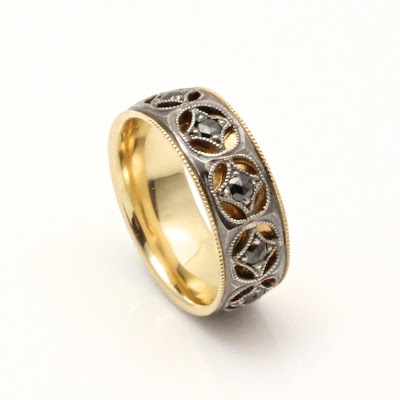 Neff began his career while still in high school, apprenticing with a jewelry maker in Cincinatti, Ohio. At San Francisco’s Revere Academy, he studied jewelry fabrication, and over the last two years 85 percent of his work has focused on stone setting. “People come to me with the complicated projects that other people turn down,” Neff notes. “One of the things I really enjoy is being able to reproduce the same bead size in metal and in each stone — if for instance there’s 40 stones, one little slip and you break a stone. There’s very, very little room for error. There’s no room to recover from most mistakes. That’s what appeals to me.”
In the current show, Neff’s obsession with working with dozens of intricate stones is exemplified in his Quatrefoil Pendant, which is one of his favorite pieces in the show. The piece required extensive fabrication work on the lathe for milling out the arches in the pattern, as well as almost three dozen black rose cut diamonds set into the oxidized silver and 18 karat gold metal.
 Nearly all of Neff’s jewelry work is based on a factor of six or a spacing of 15, 30, or 60 degrees. Neff notes that this design is influenced largely by the fact that milling reproduces those angles exactly, with more options present in a factor of six than a factor of four or five. “The angles break down really nicely,” he explains.
 Neff’s interest in design has grown in the past two years, spurred in part by the goal to show a small collection and launch a website of his own by the time he turned 30. The thirty-one-year-old Neff, whose fabrication skills are decades beyond his physical age, has accomplished both goals in admirable fashion.
Unlike Bongfeldt, whose designs favor a more industrial-influenced or overtly modern look, Neff’s designs look back sometimes centuries or more for inspiration. The Globe Ring in the current show was inspired by a 19th century ring; Neff then used modern fabrication techniques to re-create the inspiration piece as crisply and perfectly as possible.
 While Bongfeldt’s work showcases a repetition of circle patterns, several of Neff’s pieces incorporate an oxbow pattern, which he first saw in a 1908 Sears catalog illustration. Like many of his patterns, this one is deceptively simple. The curve and taper in the oxbow has to be replicated perfectly, or the entire piece looks unbalanced.
 Neff notes that while the oxbow and other simple patterns may not be groundbreaking shapes, “[T]o mill it out that small and to get the curves right and the shapes right is challenging. That’s where I get really nerdy.”
For Neff, this challenge means that he relies on more analog methods to create his work. Computer programs are much too easy of an option, and he prefers to know — and master — every step of the fabrication process. Neff noted that when he overheard a guest at the show opening hypothesize that one of Neff’s pieces must have been made with CAD, he had to let him know about the backstory on the piece, including the absence of computer-aided design or drafting. For Neff, the design is important in his work, but on equal footing is process. “When I get to my studio and sit down there’s a shift that happens. My everyday life is so quickly paced. I love to put blinders on and slow down.”
Elisa Bongfeldt and Chris Neff’s show, Visual Cadence, runs through September 30th at Shibumi Gallery.
At first glance, jewelry makers Elisa Bongfeldt and Chris Neff, featured in Shibumi Gallery’s current show, Visual Cadence, share many common factors: extensive use of oxidized silver; a near-obsession with repetition of simple forms, and a surprisingly gender-ambiguous aesthetic. The more compelling story, however, isn’t in the shared qualities of the work, but in how these two artists and their work diverge.
Berkeley-based Elisa Bongfeldt creates her jewelry pieces using a mix of 22 karat bimetal and sterling silver tubing, resulting in pieces that are decidedly forward-looking, modern, and minimalist in nature.


In the current show, Neff’s obsession with working with dozens of intricate stones is exemplified in his Quatrefoil Pendant, which is one of his favorite pieces in the show. The piece required extensive fabrication work on the lathe for milling out the arches in the pattern, as well as almost three dozen black rose cut diamonds set into the oxidized silver and 18 karat gold metal.


Unlike Bongfeldt, whose designs favor a more industrial-influenced or overtly modern look, Neff’s designs look back sometimes centuries or more for inspiration. The Globe Ring in the current show was inspired by a 19th century ring; Neff then used modern fabrication techniques to re-create the inspiration piece as crisply and perfectly as possible.


For Neff, this challenge means that he relies on more analog methods to create his work. Computer programs are much too easy of an option, and he prefers to know — and master — every step of the fabrication process. Neff noted that when he overheard a guest at the show opening hypothesize that one of Neff’s pieces must have been made with CAD, he had to let him know about the backstory on the piece, including the absence of computer-aided design or drafting. For Neff, the design is important in his work, but on equal footing is process. “When I get to my studio and sit down there’s a shift that happens. My everyday life is so quickly paced. I love to put blinders on and slow down.”
Elisa Bongfeldt and Chris Neff’s show, Visual Cadence, runs through September 30th at Shibumi Gallery.
05 December 2011
Sea and Sky: April Higashi and Aondrea Maynard
Review by Ahna Adair
April Higashi has made her name on her skillful and organic style of enameling. Building layers of color in a painterly fashion she creates small and wearable artworks rooted in a reverence for nature. Conversely, Aondrea Maynard paints large canvases in which she distills moments unseen yet present in the natural world around us. A smart pairing, the show “Sea & Sky” is a look at the evocative ways in which artists become inspired by the natural world and their relationship to it. Each artist, though very different in chosen medium and scale, is working from a deep and intuitive place, attempting to assign materiality to the intangible realm of experience.

'Ma' Brooch: painted enamel, diamond slices, 18kyg, oxidized silver
Higashi is currently navigating the challenges of new motherhood, owning and operating a gallery and continuing an art practice of her own. Despite this hectic work environment, her new collection has a sense of peace and stillness. A subtle shift has occurred in her enamels as vibrant patterns spread over the whole surface have been left behind for a more sparse imagery with soft white backgrounds. “Ma” Brooch (painted enamel, oxidized silver, 18k yellow gold, and diamond slices) exhibits a single bare branch, rendered fuzzy as if seen through thick fog. About this new aesthetic Higashi says, “I wanted to arrive at a subtle beauty that gives the viewer a sense of calm. This quiet place is a space that I crave, even if only enjoyed for the smallest moments.” These new enamels are small homages to the awe-inspiring effect of nature. Perhaps by pointing our gaze at artwork instilled with this awe we may be able to steel a moment away from the busy, overscheduled day to day.

'Shiro' Brooch: fossilized coral, black diamonds, 24&18k gold
Higashi’s reverence for nature comes through in not only the imagery painted on her enamels but the materials she uses as well. Shiro Brooch (fossilized coral, black diamonds, 24&18k gold) offers the viewer a relic from the past. Embellished very sparingly with a faux branch reproduced from gold and set with black diamonds gives the piece a feeling of elaborate repair. Like many jewelers, Higashi works with precious metals, stones and pearls. Always careful to use only those that are responsible and sustainable, her eye falls on the peculiar. The pearls, stones and other precious materials seen in this show shed light on her special interest in the beauty of imperfection. Those things that nature makes sub-par or irregular, according to market standards, are the very materials that she covets. The asymmetry of a branch of fossilized coral, a domé pearl originally used as a test to make cultured pearls, and raw diamonds mined decades ago to make industrial tools hold the spotlight in this extensive body of new work.

Lover, 2011: oil on wood panel, 22" x 60"
Aondrea Maynard’s paintings are at once beautiful and haunting. Capturing the liminal, she creates a visual language for the moments that happen in between what we might consider regular and documentable events. In many of her paintings, namely Lover (oil on wood), light and color are a strong focus and occupy the canvas with as much weight as line and shape. What looks like puffs of smoke, upward moving steam, and currents of air are rendered as tangible as a full moon or the silhouette of tree tops. A reoccurring shape appears, reminiscent of the end of a cello or violin or perhaps the ubiquitous Acanthus leaf. In Whaling Song, the shape has such a weight and shadow that it becomes animate, a living and breathing being. For the artist it is a shape that feels good to paint and her body has a natural tendency towards it. In this way a language specific to the artists physicality has become part of the visual language of her painting.

Whaling Song, 2011: oil on wood panel, 40" x 36"
Challenges of sustaining a successful art practice are present for both artists. In Maynard’s short talk given during the show opening she spoke of the dangers of getting stuck in an aesthetic that sells well. For a painter whose aim is to paint the invisible, she has to try to shelve this looming demand of marketability and get to that deeper place that many artists seek. For Higashi and Maynard continuing a successful studio practice while striving toward their true creative vision is not easy in the midst of life’s daily challenges. In “Sea & Sky” we are offered an unusual comparison of the work of two artists, a jeweler and painter. Similarly inspired, the careers of two women converge at Shibumi Gallery as they exhibit their most recent bodies of work.
For those unable to steel a moment from their day-to-day, visit Shibumi Gallery's Flickr page where you will find April Highashi's jewelry collection, Aondrea Maynard's paintings as well as photos from the opening.
07 May 2011
Darcy Miro at Shibumi Gallery
Review by Ahna Adair
Since she began her art practice, Darcy Miro has covered an extensive territory with her metalwork. Her ability to adapt to various art markets is noteworthy, operating within the fields of fashion, design, art jewelry, and sculpture. Comfortable dwelling in the minute and the gigantic, her resume lists high profile projects such as her participation in the façade design of the American Folk Art Museum in 2001 with architects Tod Williams and Billie Tsien.

The collection showing at Shibumi Gallery consists primarily of pendants and cuffs with some earrings and rings interspersed. Their arrangement on a white exhibition table brings attention to the specimen like quality of the work and peering down at over 50 small abstract forms is not unlike a visit to the natural history museum. A slight break in continuum from her raw and imperfect aesthetic happens with the pendants strung on smooth black ribbon. Here the viewer is plainly reminded that these objects function as pieces of adornment.


Since she began her art practice, Darcy Miro has covered an extensive territory with her metalwork. Her ability to adapt to various art markets is noteworthy, operating within the fields of fashion, design, art jewelry, and sculpture. Comfortable dwelling in the minute and the gigantic, her resume lists high profile projects such as her participation in the façade design of the American Folk Art Museum in 2001 with architects Tod Williams and Billie Tsien.

Pierce and Stripe Cuff, 2011, oxidized silver, black diamonds, 2.5"x 3"x 2"

Medium Pendant Seven, 2011, oxidized silver, black ribbon, 1.75" x 3.25"
While the work is a cohesive body of jewelry, Miro does not identify as a jeweler, preferring instead the broader title of metal sculptor. Balancing between the mark of nature and that of the maker, her forms are intuitively constructed, translated first into wax and then cast in sterling silver and 18k yellow gold. The majority of the pieces in the show, far from pristine and highly polished, are treated with a dark patina, leaving solder and scorched metal exposed.
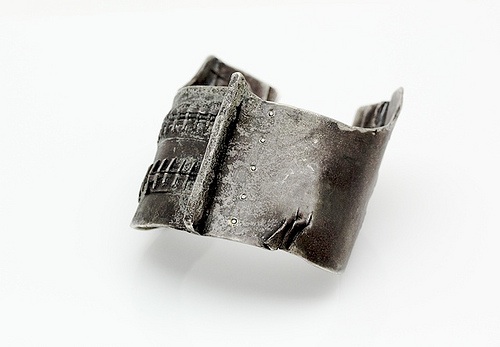
Short Stitch Cuff, 2011, oxidized silver, black diamonds, 2.5"x 3"x 2"
Her rich textures, referencing nature, architecture and the body, are a sultry marriage of the primordial and the high tech; what once was becomes tangled with what is. Each piece functions as a fleeting moment, a snapshot of the artist’s psyche as her conscious and unconscious observations of the day-to-day spill out onto the wax to eventually be made permanent in metal. Subtly sprinkled with black diamonds, the familiar sparkle acts as a sugarcoating as if to assure us that what we are looking at is beautiful. And it is.
Miro’s upcoming projects include installations at E.L. Butler in NYC, Art Basel in Miami and a large wall relief in Abu Dhabi.

Wire Tie Ring, 2011, oxidized silver, black diamonds, 1" x 1" x 1"
Ahna Adair is a jeweler, artist and writer based in Oakland, CA.
30 October 2010
Raïssa Bump: “Circulation”
Musings on her current body of work followed by a conversation with the artist.
 There is something so irresistible in the prospect of tying up loose ends and making honest work out of our starts and stutters. It’s an urge that permeates across disciplines and vocations. At some point we’ve all yearned to find a home for our unfinished things, a place where they can rest and in turn put our mind at rest. Raïssa Bump has taken this simple urge and expanded on it, creating a complex body of work that utilizes her unfinished bits and pieces, collected over a 20-year period, in combinations to make brooches, earrings, and necklaces.
But this work is more than just sorting out old projects and sifting through unfinished endeavors. In an intricate collaboration with herself, this body of jewelry collages together pieces made by the artist at varying stages along her journey as a maker. Pieces from the 7-year old Raïssa combine with those from the 27-year old Raïssa and as if before your eyes, they become new again. She has thoughtfully folded in each part with skill and sophistication, allowing each new piece to stand on it’s own. The end result is a body of jewelry, both edgy and elegant.
In compliment to this current project, the show includes a selection of Bumps knitwear. Working back and forth within jewelry and knitwear, Bump engages in a constant conversation between these two dynamic segments of her studio practice. Her humble yet sexy garments hang in the gallery as a backdrop, illustrating her complete vision of adornment as a vehicle for non-verbal communication and self-expression.

Raïssa Bump received her B.F.A. in Jewelry and Metals at Rhode Island School of Design and studied at Alchimia School of Contemporary Jewelry in Florence Italy. She has taught at various colleges including the revered Penland School of Crafts and locally at Diablo Valley College. I had the opportunity to talk with her about her practice and her current body of work being shown at Shibumi Gallery in Berkeley. Read what Raïssa has to say about her current show, “Circulation” and then go see the work.
One of the last things that we were talking about at your opening was sketching in 3-dimensions with tangible objects vs. making an actual drawing and you said that it was difficult for you to get ideas out by planning on paper. On the other hand there are artists who need that plan or blueprint before they can begin to make a piece. So, what is it about that type of artist production that is more fruitful for you?
Probably because, in one way, my skills with drawing are not as developed but that’s besides the point because I think if drawing felt right to me I would find ways to make it more of an outlet. I certainly don’t feel like I need a blueprint before I start. Regardless of where the idea is, I like to have a tangible beginning point and then just work from there and evaluate as I go along.
I work through my hands. That’s where my spirit connects. I think it’s how I experience life too. It’s more about the experience and being able to see it instead of just imagine it. I can respond a lot more to that. And for me it’s harder to make decisions if something doesn’t already exist. I find that I can be more responsive and have a clearer idea about a piece when I’m brainstorming in 3-dimensions. And after all, the end result is a 3-dimensional thing. That’s probably why I have so many leftovers.
Right, instead of a sketchbook you probably have boxes and piles and things like that.
Yeah, its gives me more information. For the most part, I sketch after I already have an idea I’m working out in 3-dimensions and I say to myself, “before I go to the next stage I’m going to draw this out in different sizes so I can get a visual. Or I cut it out in paper. Paper is more tactile.
So then, along those lines how do you know when you’re finished? How do you know when you have reached the end product so to speak?
That’s not always so direct and so easy. I have a table where I have bits and pieces that I’ll arrange in a composition. I’ll leave it like that for a day or maybe I’ll move it around or add something else and feel it out. It’s a lot of intuition, of allowing time. It doesn’t always happen fast. I look at a composition for a while and then I start putting it together, actually constructing it. Eventually I wear it around my studio and sometimes out on the streets. I have to put it on the body and see how it wears, see how I feel in it, see how it looks when I walk in front of a mirror or if it hangs strange. I actually, especially with this body of work, make a lot of little changes at this stage. So, it’s a process of allowing enough time for each piece.
So, then are you kind of working in between pieces, going back and forth or do you tend to focus on one piece until you get it right and then move on to the next?
Rarely do I work on one piece and then go to the next and then the next. In my general process I have many pieces going on at once and it allows me to not get stressed out. Some pieces end up being something and some ideas don’t for the moment. It makes more sense to allow that time that I was talking about in order to feel the work intuitively and to keep looking at it at different moments, different moods, different times of day, different light…
The title of this show is “Circulation”. Would you in general talk a little bit about Circulation and what that means to your work?
I like the idea of this continuous motion. That was one of the things I responded to when choosing the title, this cycle and idea that one thing leads to the next in an ongoing, continuous flow. So that’s how I viewed it as I was working. It was this process of looking at myself throughout different time periods of my life and addressing that. As people, we interact with the world and we can’t avoid flow. One thing leads to the next, leads to the next and our experiences lead us to where we are today. So circulation is a reference to the years, the story, the information, the knowledge and interests that went into the work. Also, I like the idea of thinking of circulation in another context, as how things get spread. Like newspaper circulation, how something moves out and about in the world, how it circulates. It feels like that’s where I’m at in my life. I’m putting myself out there in the public and getting the work out there. I really do feel like these necklaces, earrings and brooches are lyrical collages that speak to all the different fragments of me, but at the same time can move away from me and mean something to someone else.
Right. I like that double meaning. The circulation that deals with the making of the work as well as the physical circulation of the work itself once out in the world. Especially because it is unique to a discipline like jewelry. You could make a 2-d work or a sculpture for that matter but it would be on the wall or somewhere more permanent. But jewelry is so interesting in that it’s constantly moving through the day to day.
Yeah, which is lovely. It moves from mood to mood, space to space and person to person. Jewelry does go to museums or certain places and just stay put but not in general.
As artists we tend to scrutinize what we make all the time. If I were to look back at something that I didn’t consider part of my artwork I might not care so much but when I put things in this category of, “This is my art,” then it becomes so much more magnified. I was thinking of myself going through your process and I wondered, would I want to look at pieces or parts or things that I made 15 or 20 years ago?
It’s interesting too, because some of it dates back to when I was young or even through high school when I wasn’t thinking of it in the context of, “I’m making art.” It was just that pure love of using my hands, getting time to myself and quietly doing all these intricate and repetitive things. Then on top of that, having something as a result of that time spent. I love that. I always like having nothing in my hands and then creating something, and realizing, “Wow, now I have a necklace to wear out tonight or a hat because its cold,” and having that skill is something I really am thankful for.
However, there is a time when it did start to become a harder process. For me the critical moment when it shifted was after college, when I was trying to make money and make this my thing. As far as the pieces I made during this time period, I probably took them apart so much that they are in disguise from what they originally were. They weren’t so interesting to me the way they were.
You said at the gallery talk that your household was a little chaotic and you looked forward to these times when you could steal away by yourself. In terms of this group of work I like picturing what your household was like and I was wondering if you could just give me a little bit of a background on your upbringing?
Sure. I certainly got along with my family. It’s just that I had 3 older brothers and a younger sister. We didn’t have a set routine every single day. It was just sort of, whatever needed to happen, happened. So there was a lot of flexibility in some ways and a lot of unknowns. I found myself wanting quiet time. So I would get away and do my own thing for a while. And that’s what it felt like—getting away from a constant motion.
Was that part of your parents philosophy, that flexibility?
I think that my family was willing to avoid making things super static, which I really appreciate. There were certainly rules and some formality about things. But there was rarely a time where it was just, “This is what it is and no matter what the scenario comes up, I’m not going to consider anything else.” That allowed for a lot to happen. It’s interesting because the house was always changing. We were fixing the house, furniture would move around and in a sense there was a lot of creation.
I was wondering if you had one piece out of the group that especially spoke to you and if you could elaborate.
 It’s not so easy to just pick one but I really like the way this piece came out. I feel like it can be worn in different ways. I wore it with a t-shirt and thought it looked great and it felt really good. It also can be dressy and formal. A lot of this exhibition is versatile like that. In this necklace, there is a beautiful interaction between the old and the new. From afar you see it’s line quality and then up-close you see these different elements of texture and color. I like the color interaction in the piece. It’s subdued but still feels very expressive yet very simple.
Subscribe to:
Posts (Atom)

 Posts
Posts


